
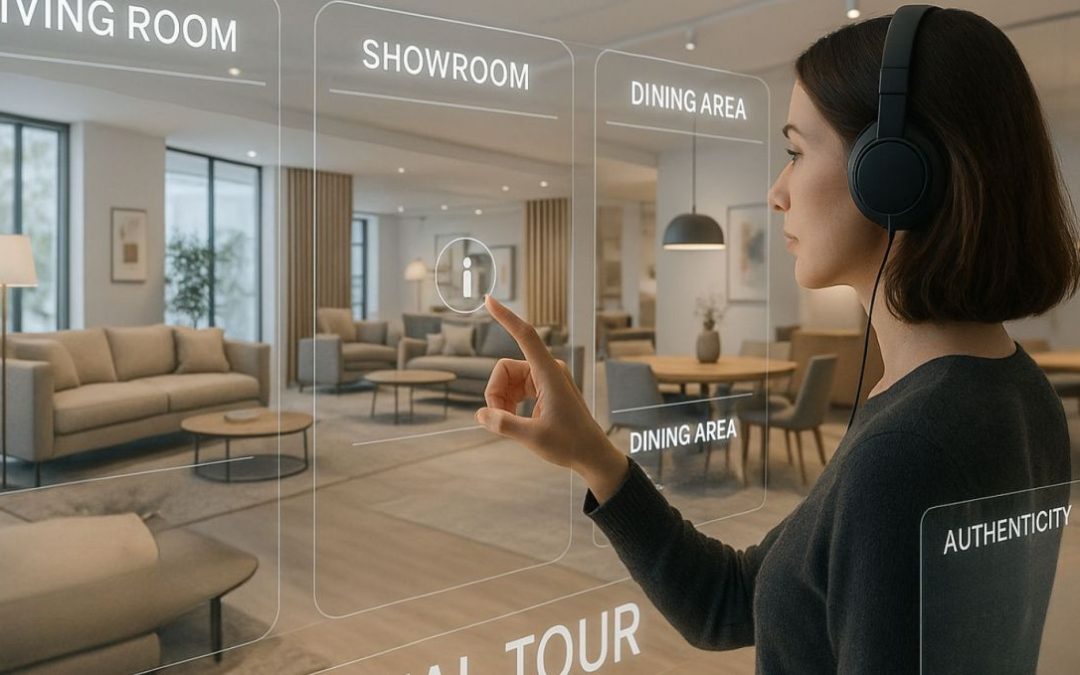
Immersive experiences: AR/VR and virtual tours for manufacturing
When experience becomes digital (without losing authenticity)
Is there a way to bring customers, designers, and partners into the company without physically opening the doors, without organizing visits or events?
Yes, there is—and it’s not science fiction. It’s a concrete and increasingly accessible possibility for businesses in the Venetian artistic manufacturing sector: immersive experiences built with simple digital tools but with strong emotional impact.
In recent years, technology has provided tools such as augmented reality, virtual reality, virtual tours, and digital twins. Terms that once seemed reserved only for large industries or international museums are now becoming accessible levers for SMEs as well, when integrated into a coherent strategy.
It’s not about replacing physical relationships. It’s about amplifying them, making them possible even remotely, turning the screen into a bridge, not a barrier.
It’s not a show: it’s enhanced connection.
One of the most common fears is that the use of technology might “distort” the artisanal value.
But the opposite is true: when identity is solid, technology enhances it, making it more visible, more accessible, more desirable.
A well-executed virtual tour does not diminish the value of an in-person experience: it prepares, tells, and strengthens it.
A narrative QR code is not just a modern label: it is a gateway to stories, videos, processes, and content.
A digital twin is not a sterile copy: it is a faithful and immersive representation designed for clients who cannot be there but want to understand, see, and trust.
This approach perfectly aligns with work on digital identity, as it transforms seemingly technical tools into emotional and relational experiences.
Narrative QR codes: the first simple, concrete, effective step
Among the most immediate solutions are narrative QR codes. Placed on a product, packaging, or showroom wall, they allow access to digital content: a video, an interview, a gallery, or an audio note from the creator.
No complex apps are needed. Just a smartphone.
And perceived value grows because you enter the product’s story.
An object that tells its story, even when its creator isn’t there to explain it.
A simple gesture that creates connection and memory.
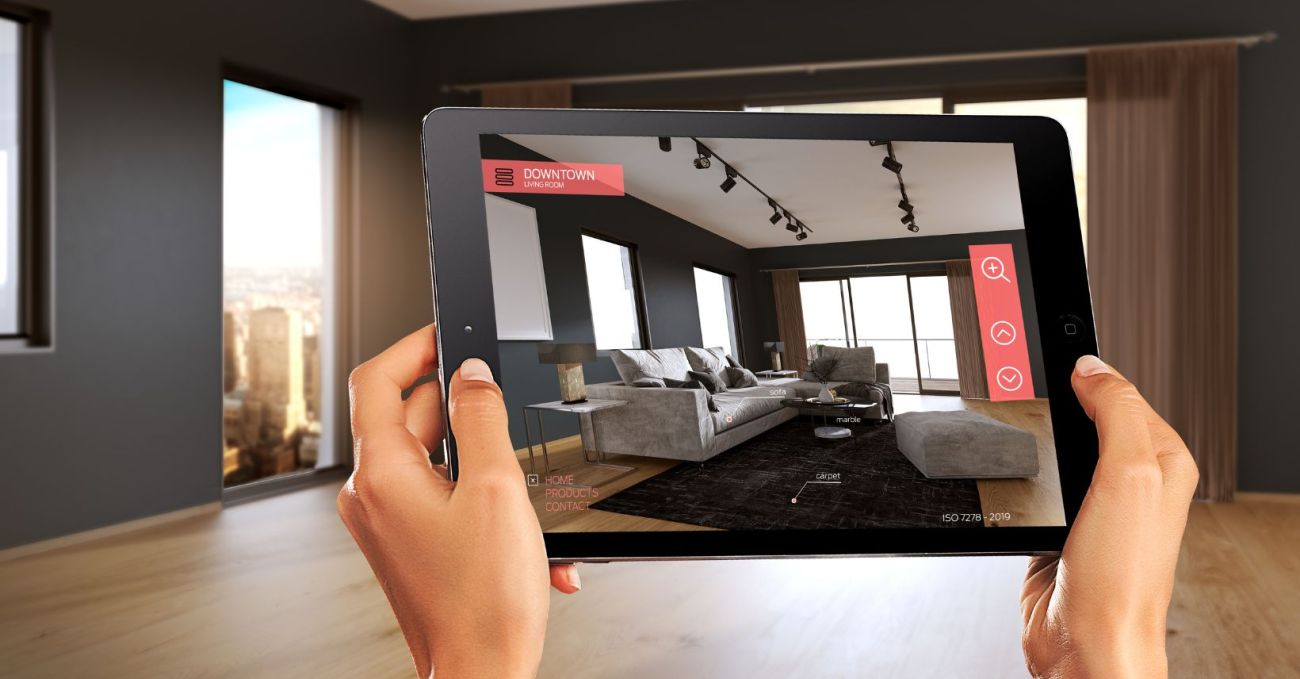
Virtual tour: the atelier, the showroom, the workshop… anywhere
Creating a virtual tour of the company allows customers, buyers, designers, journalists, and partners to explore the production spaces, see tools, materials, and environments.
It’s a visit without time constraints or geographical boundaries.
This type of experience:
- builds trust before a meeting;
- strengthens transparency;
- complements the physical exhibition.
Perception changes radically: from an isolated object to a coherent world.
And when the tour is integrated with audio, descriptions, or links to narrative content, it becomes a true guided experience.
Augmented reality and digital twin: the product enters the customer’s space
With augmented reality, a customer can visualize an artistic product in their own environment. A vase on a table. A mosaic on a wall. A metal structure on a façade.
The technology allows the artifact to be superimposed onto the real space with correct proportions. It’s a concrete way to increase trust and purchase intent, especially in complex projects.
The digital twin, instead, is a digital and navigable version of a product or a production context. It’s not a 3D photo: it’s a living replica that can be explored, rotated, disassembled.
This approach fits perfectly with the logic of emotional packaging, transforming even the post-purchase experience into an opportunity for storytelling and connection.
Experiences accessible even for SMEs
Contrary to popular belief, these technologies do not require exorbitant budgets.
Today, there are streamlined services, intuitive platforms, specialized photographers and videomakers, plug-and-play solutions.
What matters is having:
- a clear narrative strategy;
- consistency between physical and digital;
- a gradual plan that allows testing and improvement.
There’s no need to start with everything at once. You can begin with a 360° tour, a narrative QR code on a product line, an immersive video for the website.
The real mistake is not doing enough. The real mistake is doing nothing.
Immersion as a lever of differentiation
In a market where many speak, few truly engage. An immersive experience—if well crafted—does exactly that: it engages, excites, and distinguishes.
Those who offer a handcrafted product immersed in a digital story, a virtual space, or an interactive narrative, don’t just sell an object.
They sell a system of values, a vision, a way of seeing the world.
And here Venetian artistic manufacturing has an advantage: it already has the substance.
It just needs to give it shape digitally as well.
Do you want to transform your company presentation into an immersive experience?
Join the Euteknos network to access tools, training, and support on narrative QR codes, virtual tours, and augmented reality.
Start telling the story of artistic manufacturing even remotely, with coherence and impact.

